
Dean Moor Solar Farm
Dean Moor Solar Farm is located between the villages of Gilgarran and Branthwaite in West Cumbria.
If approved, the project would include the construction, operation, maintenance and decommissioning of a solar energy generating station, comprising solar photovoltaic arrays, landscape and biodiversity enhancements, and associated infrastructure.
What is being proposed?
The Proposed Development is located on approximately 279.50 hectares of land and has been designed to generate renewable electricity while incorporating landscape, ecology and biodiversity measures.
Solar photovoltaic panels would generate clean, renewable electricity for export to the grid.
The proposals include landscape and biodiversity enhancements as part of the overall Project design.
A Community Benefit Fund would support the local community through the operation of the solar farm.

Project location
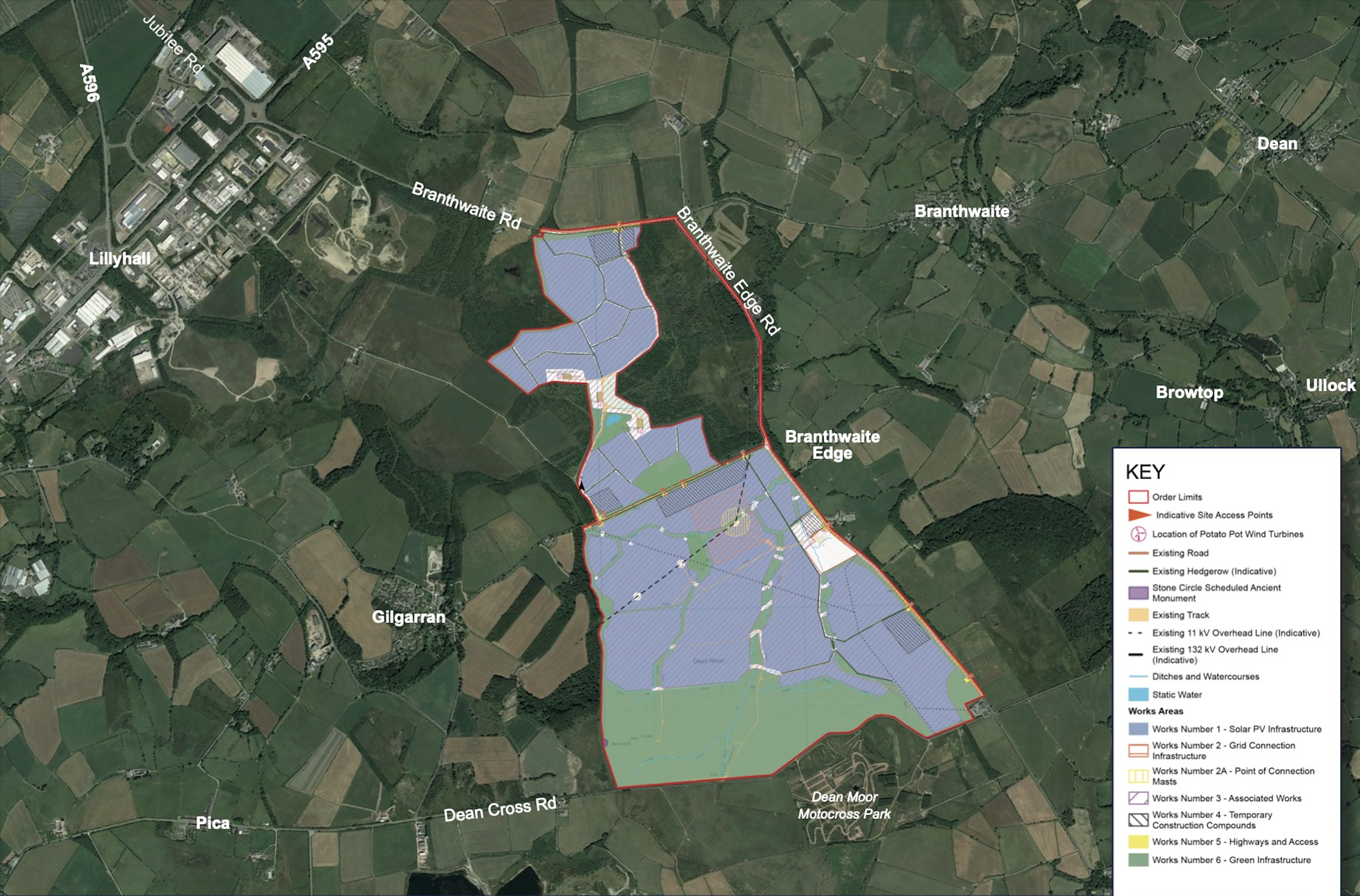
The project is located between Gilgarran and Branthwaite in West Cumbria. The map above shows the location of the Proposed Development.
Indicative layout
The Site Concept Layout shows the indicative arrangement of the Proposed Development, including solar PV arrays, associated infrastructure, landscape proposals and areas for biodiversity enhancement.
Please refer to Figure 3.1 in the PEIR, available on the Documents page, for a non-stylised version of the proposed Concept Layout.
Project timeline
The timeline below summarises the main stages of the Dean Moor Solar Farm planning process.
Early project development and preparation for consultation.
Informal public consultation on the early proposals.
Feedback was reviewed alongside technical and environmental work.
Formal statutory consultation was carried out before submission of the DCO application.
The application was submitted to the Planning Inspectorate.
The application was examined by the Planning Inspectorate.
The Secretary of State will publish its recommendation via a Section 134 Notice.
The Development Consent Order process
Dean Moor Solar Farm is considered a Nationally Significant Infrastructure Project because of its potential to generate over 50MW of electricity. This means the project requires a Development Consent Order for construction and operation.
Public consultation is an important part of the DCO process. Feedback received during consultation, alongside technical evaluation and environmental studies, was considered when developing the final proposals submitted to the Planning Inspectorate.